
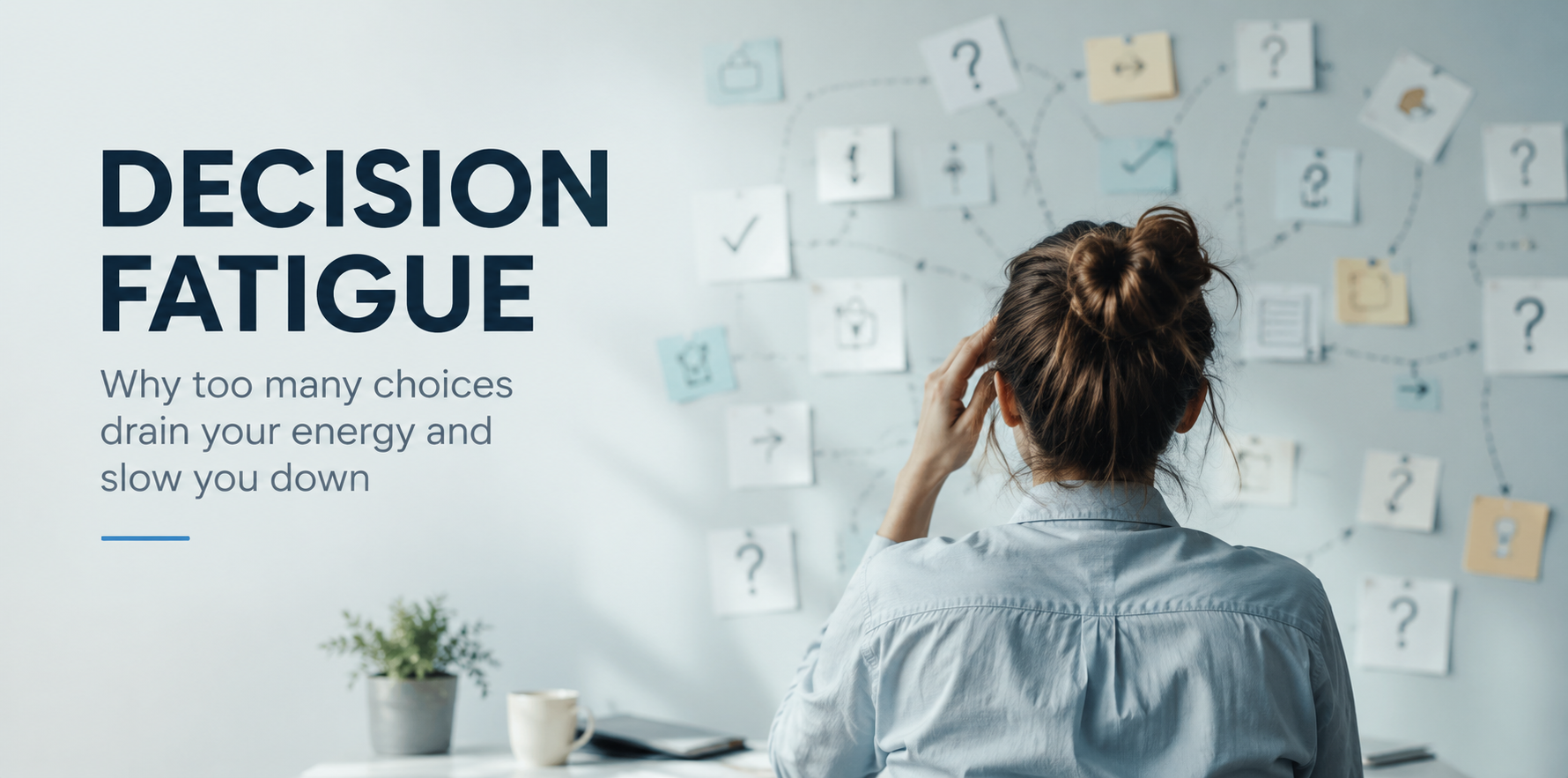
You handled a full day of decisions without falling apart. Then you got home, opened the fridge, and stood there for five minutes unable to decide what to eat. Not because there was nothing in it. Because you had nothing left to decide with.
This isn’t a discipline problem. It’s a resource problem, and the resource is called decision fatigue.
What decision fatigue actually is
Every decision you make, no matter how small, draws on the same limited mental reserve. It doesn’t matter if the decision is life or death or completely trivial. Your brain treats them the same way at a resource level: each one costs something, and that cost adds up across the day.
Researchers have measured this in some surprising places. A well known 2011 study looked at parole judges in Israel and found that the odds of a prisoner being granted parole started at around 65% early in a session and dropped close to zero by the end of it, before jumping back up after a food break. The judges weren’t becoming less compassionate. They were becoming depleted, and the easiest decision under depletion is usually the one that requires the least follow-through, which in that case meant saying no.
It’s worth noting that other researchers have since questioned how large this specific effect really is, and some follow-up studies in different legal settings found much weaker patterns. Decision fatigue is real, but it isn’t a switch that flips the same way for everyone in every context. What does hold up across many studies, in fields from healthcare to finance to academic publishing, is the general direction: the more decisions a person makes in a row, the more likely they are to default to the path of least resistance on the ones that follow.
Closer to home, researchers studying general practitioners’ prescribing patterns found a similar shape. As the workday went on, doctors became more likely to prescribe medications that required less thought, like antibiotics, and less likely to prescribe ones that needed more deliberation, like statins for long term risk management. Nobody planned to prescribe differently at 4pm than at 9am. It happened anyway, because the mental budget for weighing options had already been spent on everything that came before it.
Why this matters more at the end of a shift
If your day involves constant small decisions, which patient to see first, whether a reading needs a second look, how to prioritise an inbox, which task to hand off, you’re spending that budget faster than someone whose day has fewer decision points. By the time you clock off, there may be almost nothing left for the decisions that are supposed to be easy: what to eat, whether to exercise, how to respond to a message that deserves a thoughtful reply.
This is why “just be more disciplined” doesn’t work as advice. Discipline assumes there’s a reserve to draw on. Decision fatigue means the reserve is already gone. Telling someone to try harder at 6pm is like telling an empty fuel tank to drive faster.
The fix isn’t more willpower, it’s fewer decisions
The most effective way to deal with decision fatigue isn’t fighting through it. It’s designing your day so there are fewer decisions to make in the first place.
This works because a decision only costs mental energy the first time you have to weigh it. After that, if it’s built into a routine or a fixed system, it stops being a decision and becomes a habit, and habits are nearly free to run.
A few examples of what this looks like in practice:
- A fixed evening routine. If dinner, exercise and wind-down are on a loose rotation rather than decided fresh each night, there’s nothing left to negotiate with yourself about at 8pm.
- A default answer for common requests. If you already know your standard response to the three most common asks in your inbox, you’re not drafting a fresh decision each time, you’re applying a template.
- A fixed spot for recurring items. Keys, chargers, your bag for tomorrow. If it always lives in the same place, “where did I put that” never becomes a decision at all.
The same principle scales up to physical work environments, and it’s a big part of why equipment layout matters more than people usually give it credit for. A dressing trolley with a fixed shelf layout means nobody has to decide where supplies live today, because they already know. An instrument trolley with a dedicated slot for every tool removes a small decision every single time someone reaches for it. A locked medication cabinet with one home for every item means the search is already solved before it starts. None of these are dramatic changes. They’re just decisions that got made once, permanently, instead of being remade a hundred times a shift.
If you’re setting up or rethinking a space where a lot of small decisions happen daily, it’s worth browsing Hospital Furniture with this lens specifically: not “what looks good” but “what removes a decision nobody should have to make twice.”
The takeaway
Decision fatigue isn’t a personal failing, and it isn’t fixed by trying harder at the end of an already long day. It’s fixed earlier, by building systems, routines and layouts that take as many small decisions off your plate as possible, so the energy you do have left goes toward the choices that actually deserve it.



 No products in the cart.